What dystopian fiction tried to teach us about power, and why I keep recognizing the warning signs
Sep 05, 2026
I think I know when this started. Kristi Noem floated the idea of a reality television show in which immigrants could compete for American citizenship. Citizenship. As a prize.
My first reaction was probably similar to a lot of people’s: what the actual hell. My second reaction was stranger. I thought, I’ve seen this movie. Not literally, of course. But I knew the story. People competing for something fundamental to their existence while an audience watches, power deciding who gets to stay, who gets to belong, who gets rewarded and who gets discarded. The Hunger Games. The Running Man. And now we have the Trump administration’s “Patriot Games” concept layered onto that same imagery of competition, nationalism and spectacle.
Suddenly all those dystopian books and movies I have read or watched over the years started crawling out of the back of my brain. 1984. Fahrenheit 451. The Handmaid’s Tale. The Testaments. Brave New World. Animal Farm. Soylent Green. The Long Walk. Minority Report. The Terminator. Logan’s Run. Demolition Man. District 9. And many more.
And I started thinking, wait, what exactly were these stories trying to warn us about. Because maybe we’ve misunderstood the purpose of dystopian fiction. They weren’t playbooks. They were warnings. And they weren’t necessarily predicting the future. They were teaching us how to recognize the machinery that could create one.
THE MISTAKE WE MAKE WITH DYSTOPIAN FICTION
When someone compares something happening today to 1984 or The Handmaid’s Tale, there is almost always someone ready to respond that’s ridiculous, America isn’t Gilead. No, it isn’t. That’s not the point. Dystopian fiction isn’t a checklist where we have to reach 100 percent similarity before we’re allowed to be concerned.
The Handmaid’s Tale doesn’t have to become reality in its entirety for reproductive authoritarianism and theocracy to be worth recognizing. We don’t have to have telescreens in every home for surveillance like 1984‘s Big Brother to be worth questioning. We don’t need Fahrenheit 451‘s “Firemen” book burning trucks in the streets for censorship to matter. We don’t need Skynet to become self aware before we ask whether we’re building technology faster than we’re thinking about its consequences. And we don’t need actual precogs, the psychic kids Minority Report imagined predicting murders before they happen, before we ask what happens when governments and corporations can track where we go, who we meet and what we’re doing at an unprecedented scale.
The warning isn’t “this exact fictional world is coming.” The warning is watch what happens when these individual pieces are allowed to grow.
RED FLAGS I’VE BEEN WATCHING FOR
Here’s the short version, before I go deep on each one. If you don’t have time for the whole essay, here’s the pattern I keep seeing, and which stories tried to warn us about each piece of it.
Turning survival into spectacle. Hunger Games, The Running Man, The Long Walk. When something people need to live gets turned into a competition for an audience.
Citizenship as a game show prize.
Teenagers performing patriotism for scholarship money while the cameras roll.
Propagandized patriotism packaged for television.
The tell isn’t that people are competing, it’s that someone decided their need should be entertainment first, and propaganda second.
Controlling what people are allowed to know. 1984, Fahrenheit 451. Not one dramatic bonfire. A slow accumulation of “protecting kids,” of books quietly pulled from shelves, of complexity treated as the problem instead of the point. Nearly 23,000 school book ban instances since 2021 isn’t a metaphor, it’s a number [4].
The state deciding who has legal say over a body. The Handmaid’s Tale. Not a hypothetical. Adriana Smith’s family had no legal say when Georgia’s fetal personhood law kept her body on life support for months against their wishes [7]. In a separate case, a Florida woman in active labor had a judge wheeled into her delivery room on a tablet to tell her how her body needed to do what her body was already doing, the courtroom brought to her mid labor instead of the other way around [8]. When the law decides a body isn’t fully yours anymore, that’s the chapter, not the metaphor for the chapter.
Redefining a right until it quietly means less. Animal Farm, 1984. The words stay the same. Freedom. Equality. Title IX. What they protect gets smaller and smaller until one day you notice the promise and the policy aren’t pointing at the same thing anymore. Watch the language, this is Orwell’s “war is peace”, “freedom is slavery”, “ignorance is strength” playing out slower and quieter. Watch what changes underneath the words while nobody’s renaming anything.
Surveillance normalized as safety. Minority Report, 1984. Cameras that don’t just watch, they predict. Cell site simulators sweeping up everyone nearby, not just the target. The pitch is always safety. The infrastructure doesn’t care what it gets used for once it’s built.
Deciding who counts as useful, or who counts as human. Logan’s Run, District 9, One Flew Over the Cuckoo’s Nest. Worth is measured in productivity. Disability benefits require proving you’re too unwell to work while somehow also proving you’re well enough to navigate an impossible system. Immigrants become a “logistical problem” before they become anything else in the language used about them. Watch what happens to how people get talked about right before it gets easier to justify what happens to them.
Comfort and distraction standing in for consent. Brave New World. Nobody has to drag you into the street. They just have to keep you exhausted, entertained, and arguing with the person next to you instead of the people making the decisions.
Building the technology before building the guardrails. The Terminator. We keep answering “can we” before we’ve finished answering “should we,” and the safeguards show up, if they show up at all, after the thing is already load bearing.
None of these on their own means we’re living inside the book/ movies world. That’s not the argument. The argument is that you don’t need the whole dystopia to show up at once for it to be worth noticing the pieces that already have.
1984: WHEN CONTROLLING INFORMATION BECOMES CONTROLLING REALITY
George Orwell’s 1984 [1] is probably the dystopian reference everyone reaches for first. Surveillance. Propaganda. Government control of information. Manipulation of language. Rewriting history. Creating enemies. Convincing people that reality is whatever the state says it is.
But the part that sticks with me isn’t simply Big Brother watching. It’s the idea that if you can control information, you can eventually control people’s understanding of reality. You don’t necessarily have to convince everyone that something false is true. You can overwhelm them with contradictory information until they stop believing they can know what’s true at all. That’s when “truth” becomes a political weapon. And that should concern us regardless of which political party is in power.
Orwell called this “doublethink”, holding two contradictory beliefs at once and accepting both. “War is peace”. “Freedom is slavery”. “Ignorance is strength”. “Two plus two equals five” if the Party says it does. That’s not just a device from the novel, it’s a mechanism, and I hear echoes of it every time a piece of rhetoric asks me to reject something I watched happen with my own eyes. “Fake news”. “Stop the steal”. “Deepfakes” muddying what’s real footage and what isn’t, until people stop trying to tell the difference at all. In the novel, Winston Smith writes in his diary that “the Party told you to reject the evidence of your eyes and ears” [2], the final and most essential demand any authoritarian system makes once it has enough power. We’re not there. But the muscle being built, the practice of doubting your own senses because an authority told you to, is the same muscle.
*Side note: If you haven’t seen Orwell: 2+2=5 documentary written, produced and directed by Raoul Peck yet, I highly recommend it.
FAHRENHEIT 451: YOU DON’T HAVE TO BURN EVERY BOOK
Ray Bradbury imagined [3] a society where books were destroyed. We often remember the fire. We sometimes forget the social conditions that allowed the fire to happen. A society can become uncomfortable with complexity. People can decide difficult ideas are offensive. Institutions can decide certain books are inappropriate. Parents can demand removals. Politicians can turn education into a culture war battlefield. And eventually, fewer people encounter the ideas in the first place.
That matters because we’re not talking about some theoretical history lesson. PEN America documented 6,870 instances of school book bans during the 2024 to 2025 school year and nearly 23,000 since 2021 [4]. And among the books caught up in this modern censorship wave are some of the very dystopian novels that warned us about censorship. Fahrenheit 451. 1984. The Handmaid’s Tale. Brave New World. The Hunger Games. The Long Walk. At some point the irony becomes difficult to ignore. What does it say about us when books warning us about censorship become targets of censorship themselves?
THE HANDMAID’S TALE: WHEN IDEOLOGY GETS CONTROL OF THE BODY
Margaret Atwood didn’t write The Handmaid’s Tale [5] as a prediction of one particular American administration. She constructed Gilead from real historical examples of governments and religious extremist movements controlling women’s bodies. That’s what makes it so frightening. It doesn’t require magic. It requires political power, the right people gaining enough control over institutions, the right ideology becoming law, and women’s reproductive autonomy becoming something the state believes it has the authority to regulate.
When reproductive rights are restricted, I don’t think the honest question is “is this Gilead.” The better question is which part of Gilead’s warning are we being asked to ignore. And there’s a detail in Atwood’s world worth sitting with here. In Gilead, women are stripped of the right to read at all. So there’s a particular irony in a book warning us what it looks like when women lose the right to read being pulled from shelves and out of classrooms. The censors are, in their own small way, proving the book’s point for it.
Switching from the books to the adapted TV series for a second. There’s a specific episode I keep thinking about too. Season three, episode nine, “Heroic.” June is forced by Aunt Lydia to keep vigil in the hospital room of Ofmatthew, another handmaid who has been shot and left brain dead, her body kept functioning purely to carry her pregnancy to term. Gilead doesn’t grieve her as a person anymore. She’s a vessel now, and June is made to kneel beside that vessel as punishment [23].
I didn’t expect to be writing about that scene as anything other than fiction. Then Adriana Smith happened.
And now The Handmaid’s Tale itself has been repeatedly targeted in American schools. PEN America has documented more than 100 bans of the novel since 2021 [6]. That’s a hell of a thing to sit with.
A book warning about authoritarian and theocratic control over women is being removed from some classrooms at the same time that reproductive rights remain a major political battleground. Neither the book nor the show needs to be perfectly replicated for the parallel to matter, that’s rather the point of putting both versions of the story next to what’s actually happening.
THE HUNGER GAMES: WHEN SUFFERING BECOMES ENTERTAINMENT
Then there’s The Hunger Games [9]. This is where my brain went when I heard about citizenship being turned into a possible television competition. The Capitol doesn’t merely control the districts, it turns their suffering into entertainment. The spectacle matters. The audience matters. The performance matters. The powerful aren’t simply exercising power, they’re putting power on television.
That’s where the idea of Patriot Games caught my attention. Again, I’m not saying the administration recreated The Hunger Games. Clearly it didn’t, and it couldn’t get away with anything close to the exaggerated, lethal spectacle the books and movies depict. That’s not the argument. The argument is that the fictional warning is about something broader. What happens when political power, nationalism and human vulnerability become entertainment? What happens when people’s desperation becomes content? What happens when a government wants patriotism wrapped up in a televised bow to fit its own propaganda and narrative? What happens when the audience gets so accustomed to watching other people’s suffering that the suffering itself becomes part of the show?
PATRIOT GAMES: THE FICTION SHOWED UP WEARING A SASH
I want to be honest about my own relationship to this one. I didn’t tune in. I wasn’t going to sit down and watch a real life propaganda competition involving children as though it were regular programming. What I did was watch highlight clips and short videos afterward, the same way most people encountered it, and even secondhand it was enough to tell me what I needed to know.
Patriot Games ran August 9 through 11, 2026, at Spire Academy in Geneva, Ohio, part of Freedom 250’s semiquincentennial celebration. The premise was one boy and one girl representing every state, territory, and tribal nation, ages 14 to 17, competing for 250,000 dollars in scholarships. The pitch was best of the best. What actually showed up did not match the pitch [10].
Puerto Rico’s representative was from Texas. Massachusetts’ representative went to school in California. New Jersey’s representative attended a private Christian school in Texas, and stood in front of the camera saying “what’s up y’all, I’m representing New Jersey” in a thick Southern accent. Maine’s representative was a New Hampshire resident whose audition tape touted her school’s refusal to play a team with a transgender athlete. One boy representing Alabama told the cameras Alabama was the greatest state because of Panama City Beach, which is a well known vacation spot located entirely in Florida. Another, representing Guam, praised its mango and pineapple as reasons Guam was “the best state,” Guam being a territory, not a state [10].
There were no local or regional qualifying tournaments. Selection ran entirely on video essays reviewed by a committee, weighing patriotism, military appreciation, and faith. The application didn’t ask about race. CNN’s analysis of the roster found it skewed close to 90 percent white, heavily Christian, heavily homeschooled or private religious school, and heavily populated with kids who’d founded local Turning Point USA chapters. In an interview with The Washington Post, one participant said it felt “a little concerning not to see very many different types of people” at what was supposed to be a showcase of the best high school athletes in the country [10].
The atmosphere leaned into it. Group devotionals before events. Athletic tape printed with crosses and Bible verses. One attendee described it as feeling like a youth Christianity conference. And the competition itself had the structure of a school field day more than an elite athletic event. Only the 100 meter dash was confirmed to contestants in advance. One event used the kids themselves as literal human hurdles.
I keep coming back to the mechanism, not the mockery. This wasn’t really a competition. It was a casting call that happened to have a scoreboard. The kids weren’t selected on merit, they were selected on loyalty and then handed a state to perform, whether or not they’d ever set foot in it. That’s Hunger Games logic, the Capitol staging “representation” from districts while the actual outcome serves the story the state wants to tell. It’s Running Man logic, contestants as props for a narrative someone else controls. And it’s Long Walk logic too, forced endurance theater marketed as patriotic virtue, arbitrary judgment dressed up as merit.
The through line isn’t that these kids did anything wrong. It’s that performative nationalism substituted for the real thing, and nobody in charge seemed to mind that the substitution was visible on camera.
MINORITY REPORT: WHAT HAPPENS WHEN SUSPICION BECOMES EVIDENCE
Then I started thinking about Minority Report [11], and this one feels particularly relevant to the surveillance debate happening right now. Minority Report imagines a system capable of identifying people as future criminals before they commit crimes. Obviously we aren’t living in that world. But we are living in a world of increasingly sophisticated surveillance. ALPR cameras. Flock systems. Cell site simulators. ShotSpotter and other acoustic gunshot detection systems. Facial recognition. Predictive policing. Algorithmic risk assessments. Massive databases capable of connecting pieces of information about people that would once have remained separate.
The question isn’t whether any one of these technologies is automatically evil.
The question is what happens when suspicion becomes data, data becomes a prediction, and a prediction begins to be treated like evidence. Technology doesn’t have to be perfect to be dangerous. It only has to be wrong about the right person.
And these systems are already getting it wrong. ShotSpotter has a documented history of registering car backfires and other loud sounds as gunfire [12]. So a car backfiring near you, or a car door shutting too hard, can become the probable cause that sends officers your way expecting a gun. That’s not a hypothetical about future technology overreaching. That’s the technology working exactly as installed, and still managing to fit a narrative that assumes guilt first.
THE TERMINATOR: WE BUILT IT BECAUSE WE COULD
Then there’s The Terminator [13]. And no, I don’t think AI is secretly building an army of killer robots in a bunker somewhere. But that’s also not really what bothers me about the story anymore. The warning is about technological development without adequate consideration of consequences.
We build something because we can, then we figure out what it means afterward.
Artificial intelligence. Massive data centers. Energy consumption. Automated decision making. Surveillance. Deepfakes. Autonomous weapons. Systems capable of making decisions that humans don’t fully understand.
The question isn’t “is AI Skynet.” The question is are we building systems faster than we’re building the rules, safeguards and understanding necessary to control them. That’s a much less entertaining question. And therefore, probably, a much more important one.
We’ve already seen what it looks like when the technology outruns the judgment. I remember watching footage of a self driving taxi turning directly into an active police standoff, with a passenger still in the back seat [14]. A human driver would have seen what was happening and known not to turn there. The AI just calculated the fastest route and drove into it, because it wasn’t actually seeing the situation, it was following a rule. That’s the whole warning in miniature. Not a robot uprising. A system making a decision at scale, with total confidence, and no understanding of what it just did.
DISTRICT 9: WHO GETS TREATED AS HUMAN
District 9 [15] wasn’t the first movie to make me think about immigration, but looking at it now, its warning feels painfully familiar. The aliens are refugees. They become unwanted. They’re segregated. They’re contained. They’re described in increasingly dehumanizing language. Their displacement becomes a logistical problem. Their bodies and technology become resources for corporations and governments.
And eventually the people who once seemed completely different become frighteningly easy to understand when you realize how quickly a society can decide that someone else is the problem. That’s the part that sticks with me. First they’re outsiders. Then they’re a nuisance. Then they’re a threat. Then they’re something less than human. And once you’ve successfully convinced people that another group isn’t really “one of us,” almost anything becomes easier to justify.
I hear the modern version of this constantly. “They should have just assimilated to American culture”. And every time I hear it I want to ask, what exactly is American culture, singular. Because America is a melting pot. It always has been. There is no one culture here to assimilate into. It’s in the food on your plate, the holidays on your calendar, the music in your car, the art on your walls, the movies you love, the crafts and traditions you find beautiful, all of it built by people from somewhere else that landed here at some point. Demanding assimilation into a single culture that never existed in the first place is just another version of deciding who counts as one of us and who doesn’t.
LOGAN’S RUN: WHO GETS TO DECIDE WHO IS USEFUL
Logan’s Run [16] takes a different route. Its society decides that human beings have an expiration date. At a certain age, you’re simply no longer allowed to exist. That sounds absurd until you start thinking about the ways modern societies measure human worth. Productivity. Employability. Independence. Economic contribution. Healthcare costs. Whether someone is considered “useful.”
That’s where dystopian fiction intersects with ageing and disability rights, because one of the most dangerous ideas any society can embrace is that a person’s right to exist depends on what they can produce. And that brings me to a story that isn’t traditionally categorized alongside 1984 or The Handmaid’s Tale.
ONE FLEW OVER THE CUCKOO’S NEST: WHO GETS TO DECIDE WHO IS CAPABLE OF FREEDOM
The horror of One Flew Over the Cuckoo’s Nest [17], in both the novel and the film, isn’t simply the institution, it’s the power the institution possesses over the people inside it. Who gets to decide who’s competent? Who gets to decide who’s capable of making their own decisions? Who gets to decide whether someone belongs in the community or should be separated from it?
Those questions are at the heart of disability rights. The Americans with Disabilities Act and the Supreme Court’s Olmstead decision [18] established important protections for people with disabilities to receive services in integrated community settings rather than being unnecessarily institutionalized. And now we’re seeing renewed fights over the federal government’s role in enforcing those protections. Again, I don’t think we’re suddenly living inside One Flew Over the Cuckoo’s Nest, but I do think the book gives us a useful question. What happens when institutions decide that they know better than individuals where and how those individuals should live? That’s a question disabled people have had to fight over for generations.
BRAVE NEW WORLD: WHAT IF CONTROL DOESN’T FEEL LIKE CONTROL
Orwell imagined a world controlled through fear. Aldous Huxley imagined [19] something arguably more unsettling, a world where people are controlled by pleasure, distraction and manufactured happiness. You don’t necessarily need to force people into submission if you can keep them entertained. Distracted. Exhausted. Consuming. Arguing with one another. Constantly stimulated. Constantly angry. Constantly scrolling.
Maybe that’s one of the reasons Brave New World feels so different from 1984 today. Because control doesn’t always have to look like a boot on someone’s neck.
Sometimes it looks like giving everyone so much noise that nobody can hear the alarm.
ANIMAL FARM: WHEN LANGUAGE CHANGES, POWER CHANGES WITH IT
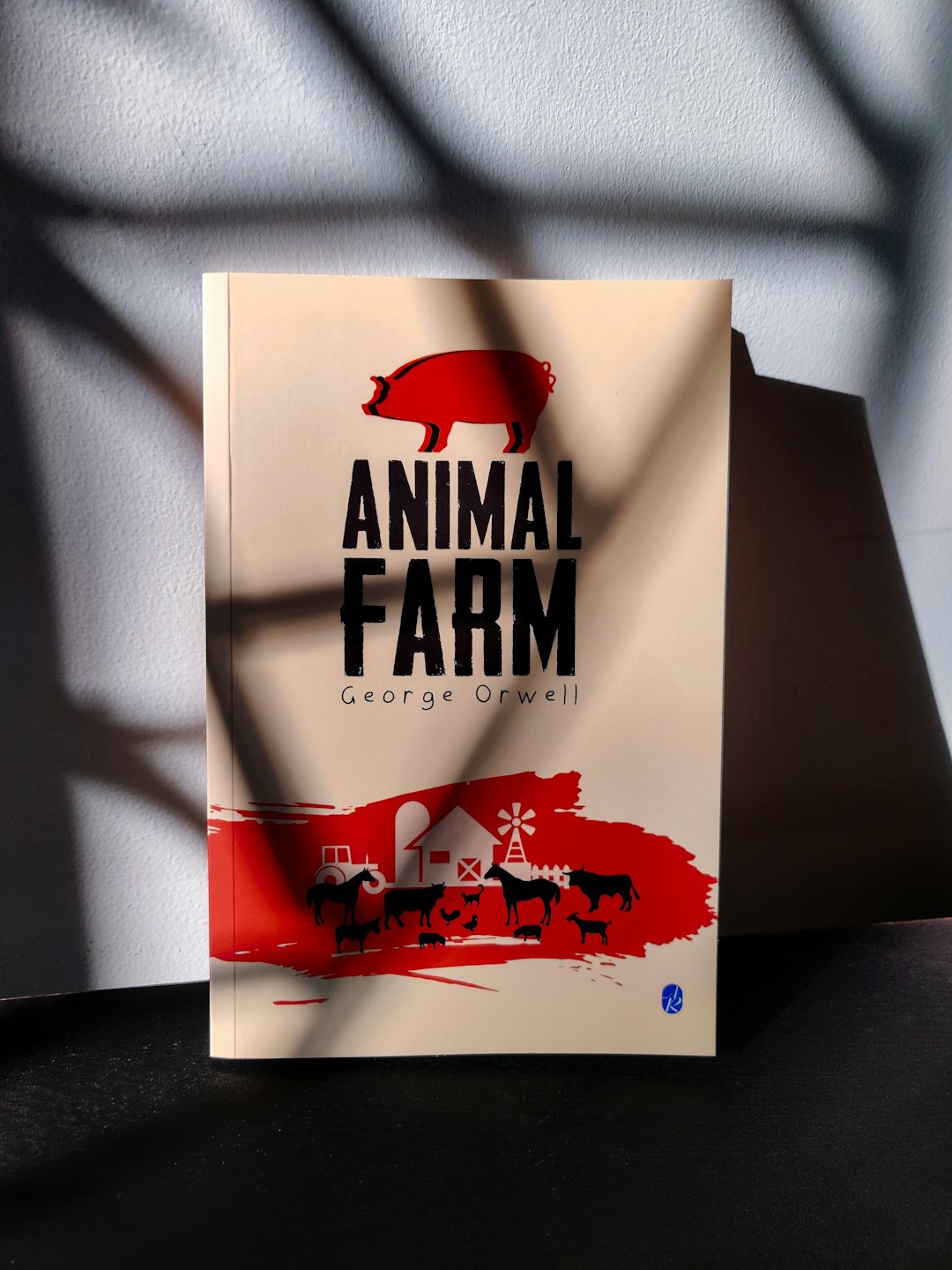
Animal Farm [20] is another one I keep coming back to. The warning isn’t simply that politicians lie, it’s that political movements can change the meaning of their own promises. Words like freedom, equality, democracy, security, patriotism can mean very different things depending on who controls the language. And once people accept the new definition, they can be convinced that they’re defending the very values that are being dismantled. That’s why language matters so much in politics. If you can redefine what words mean, you can redefine what people think they’re fighting for.
We’ve seen this in the real world with the word “entitlement”. I have heard this all the time, you probably have as well, someone saying or posting a meme “REPEAT AFTER ME: Social security is OUR money, that we earned by working and paying into the fund- EACH paycheck, and NOT an “Entitlement!” Literally describing an Entitlement Social Program. Fox news has done a good job at turning the word “Entitlement” into something bad.
SOYLENT GREEN: WHO GETS PROTECTED WHEN THE SYSTEM BREAKS
Then there’s Soylent Green [21]. Environmental collapse. Overpopulation. Extreme inequality. Scarcity. A society where the wealthy and powerful experience the crisis very differently from everyone else. It isn’t hard to see why dystopian fiction keeps returning to the same question, who gets protected when resources become scarce, and who gets sacrificed. That question applies to food, housing, healthcare, energy, climate disasters, disability services, and virtually every safety net argument we have today.
We’re living inside some version of that inequality right now. Wealth concentration at the top is as extreme as it’s been in decades. Most people aren’t anywhere close to becoming billionaires, they’re closer to becoming unhoused, one missed paycheck from losing everything, while they’re struggling just to feed a family, keep a roof over their heads, afford to have kids at all. Meanwhile the top of that pyramid keeps getting further away, insulated from consequences the rest of us live with daily, while a president who says openly he doesn’t care about gas prices, about a war he started, about the tariffs he imposed, watches corporations collect rebate checks while the people who actually paid those tariffs get nothing back but higher bills, more inflation, and more of the struggle Soylent Green tried to warn us about.
MAYBE THE MOST IMPORTANT WARNING IS THAT THESE THINGS CONNECT
This is where my list of dystopian movies and books stopped feeling like a list, because these stories aren’t really about separate problems. They’re about systems.
Surveillance can reinforce authoritarianism. Propaganda can make surveillance acceptable. Fear can make censorship feel necessary. Economic inequality can make people desperate. Desperation can make spectacle attractive. Religious ideology can be turned into law. Technology can make all of it easier to implement. And dehumanizing another group can make all of those things easier to justify.
That’s the part that scares me. Not that we’re living in 1984. We’re not. Not that America has become Gilead. It hasn’t. Not that Donald Trump is literally President Snow. He isn’t. It’s that the machinery described in these stories isn’t entirely fictional anymore. Pieces of it exist. The question is what we do when we recognize them.
THEY WEREN’T PLAYBOOKS
Maybe that’s the biggest irony of all. For generations we’ve assigned these books to students as warnings. Read 1984. Read Fahrenheit 451. Read The Handmaid’s Tale. Read Animal Farm, and so on. Learn what happens when power goes unchecked. Learn what happens when people stop questioning authority. Learn what happens when technology advances faster than ethics. Learn what happens when governments decide certain people are less deserving of rights. Learn what happens when propaganda replaces truth. Learn what happens when fear becomes more powerful than freedom.
We were supposed to recognize the warning signs. Not memorize the playbook. And that’s why I’m uncomfortable. Because I keep recognizing the stories.
This piece isn’t actually a new idea for me. I’ve wanted to write it for a long time, it’s been sitting on the back burner, pushed down the list again and again by whatever needed covering first. And that delay is worth naming, because it isn’t an accident of my own scheduling. The things this administration does move fast, faster than any one writer can track, faster than most newsrooms can track. It’s hard to keep up because keeping up isn’t really possible. That’s not a coincidence. That’s part of the playbook too, moving quickly enough that nobody has time to connect the pieces before the next thing arrives.
Not because America has become one of these stories. But because pieces of their warnings keep appearing in the real world. And maybe that’s exactly what dystopian fiction was supposed to prepare us for. Not the moment when we can finally say “this is dystopia.” The moment before that. The moment when we can still say “wait, I’ve seen this before.” And then do something about it.
Because dystopian fiction was never supposed to tell us what the future would look like. It was supposed to teach us what to watch for.

SOURCES AND NOTES
Books, films, and shows referenced
[1] George Orwell, “1984” (Secker and Warburg, 1949).
[2] The quote appears in Book One, Chapter Seven, as Winston Smith writes in his diary, reflecting on the Party’s power to alter facts and rewrite history.
[3] Ray Bradbury, “Fahrenheit 451” (Ballantine Books, 1953).
[5] Margaret Atwood, “The Handmaid’s Tale” (McClelland and Stewart, 1985); the Hulu adaptation and its sequel novel “The Testaments” (2019) are referenced alongside it.
[9] Suzanne Collins, “The Hunger Games” (Scholastic, 2008).
[11] Philip K. Dick, “The Minority Report” (short story, 1956); adapted as the film “Minority Report,” directed by Steven Spielberg (2002).
[13] “The Terminator,” directed by James Cameron (1984).
[15] “District 9,” directed by Neill Blomkamp (2009).
[16] William F. Nolan and George Clayton Johnson, “Logan’s Run” (Dial Press, 1967); adapted as the film “Logan’s Run” (1976).
[17] Ken Kesey, “One Flew Over the Cuckoo’s Nest” (Viking Press, 1962); adapted as the film directed by Milos Forman (1975).
[19] Aldous Huxley, “Brave New World” (Chatto and Windus, 1932).
[20] George Orwell, “Animal Farm” (Secker and Warburg, 1945).
[21] “Soylent Green,” directed by Richard Fleischer (1973), loosely based on Harry Harrison’s novel “Make Room! Make Room!” (1966).
[23] “The Handmaid’s Tale,” season 3, episode 9, “Heroic” (Hulu, 2019). June is forced to keep vigil beside Ofmatthew (Natalie), a fellow handmaid left brain dead after being shot, whose body Gilead keeps functioning to carry her pregnancy to term.
Real-world sources
[4] PEN America, “Banned in the USA: The Normalization of Book Banning,” 2025. PEN America documented 6,870 instances of school book bans during the 2024-25 school year across 23 states and 87 districts, and nearly 23,000 instances since 2021 across 45 states. pen.org/report/the-normalization-of-book-banning/
[6] PEN America’s Index of School Book Bans lists “The Handmaid’s Tale” with 106 bans since 2021, ranking it among the 15 most-banned titles nationally. pen.org/press-release/top-52-banned-books-since-2021-start-of-public-school-censorship-crisis/
[7] Adriana Smith, a 30-year-old Atlanta nurse, was declared brain dead in February 2025 at roughly nine weeks pregnant. Her family says they were told Georgia’s LIFE Act required her to remain on life support until her pregnancy reached viability, though the state attorney general’s office later said the law does not explicitly require this. Her son, Chance, was delivered by emergency C-section in June 2025 at about 1 pound 13 ounces. Reporting: NPR/KFF Health News, “A brain-dead woman’s pregnancy raises questions about Georgia’s abortion law,” May 21, 2025, npr.org/sections/shots-health-news/2025/06/07/nx-s1-5425384; and KFF Health News, “A Brain-Dead Pregnant Woman Was Kept Alive in Georgia,” kffhealthnews.org/news/article/brain-dead-pregnant-woman-georgia-personhood/
[8] Cherise Doyley, a Jacksonville doula in active labor at University of Florida Health Hospital, was brought into a virtual court hearing via tablet after refusing a C-section following three prior cesareans. Judge Michael Kalil presided over the roughly three-hour hearing while she was in labor. ProPublica later reported a second, similar case involving Brianna Bennett at the same hospital. Source: ProPublica, “Florida Court Hearing C-Section,” propublica.org/article/florida-court-hearing-c-section
[10] Patriot Games ran August 9-11, 2026, at SPIRE Academy in Geneva, Ohio, organized by the Trump-aligned nonprofit Freedom250 as part of America’s 250th anniversary programming. CNN’s Audie Cornish cited an internal CNN analysis on air finding the roster “overwhelmingly White,” noting many contestants attended private Christian schools and that the application did not ask about race, and that selection ran on video essays rather than qualifying events, with some students representing states where they don’t live. A participant told The Washington Post it felt “a little concerning not to see very many different types of people” at the event. Sources: Fox News, “CNN calls out Patriot Games participants as ‘overwhelmingly White,’ citing outlet’s analysis,” foxnews.com/media/cnn-calls-out-patriot-games-participants-overwhelmingly-white-citing-outlet-analysis; Yahoo News/Washington Post syndication, “The confounding, divisive messaging of Trump’s Patriot Games,” yahoo.com/news/politics/articles/confounding-divisive-messaging-trump-patriot-174150845.html. Note: the human-hurdles detail and general field-day atmosphere are your own firsthand observations from the footage you watched, not independently confirmed by an outlet, worth keeping that framing explicit in the final draft.
[12] ShotSpotter has a well-documented history of misclassifying fireworks, car backfires, and other loud sounds as gunfire. A 2021 Northwestern Law School study found 89 percent of ShotSpotter alerts in Chicago did not lead to police finding evidence of a gun-related crime, and city audits in Chicago and Pasadena found similar false-positive rates. Sources: ACLU of Wisconsin, aclu-wi.org/news/shotspotter-leak-shows-surveillance-tech-used-overpolice-black-and-brown-communities/; Wikipedia’s ShotSpotter entry summarizing the Pasadena 2023 audit and related incidents, en.wikipedia.org/wiki/Shotspotter
[14] On November 30, 2025, a Waymo self-driving taxi with a passenger inside drove through an active LAPD felony stop in downtown Los Angeles, with officers’ weapons drawn, according to viral video and multiple outlets. Waymo said the vehicle was in the vicinity for no more than 15 seconds. Source: ABC7 Los Angeles, abc7.com/post/waymo-driving-taxi-takes-passenger-active-police-scene-downtown-los-angeles/18245394/
[18] The Americans with Disabilities Act (1990) and Olmstead v. L.C., 527 U.S. 581 (1999), the Supreme Court decision establishing the integration mandate requiring services be provided in the most integrated setting appropriate.