
A continued politics are personal series by: Miss-Information
Aug. 1, 2026
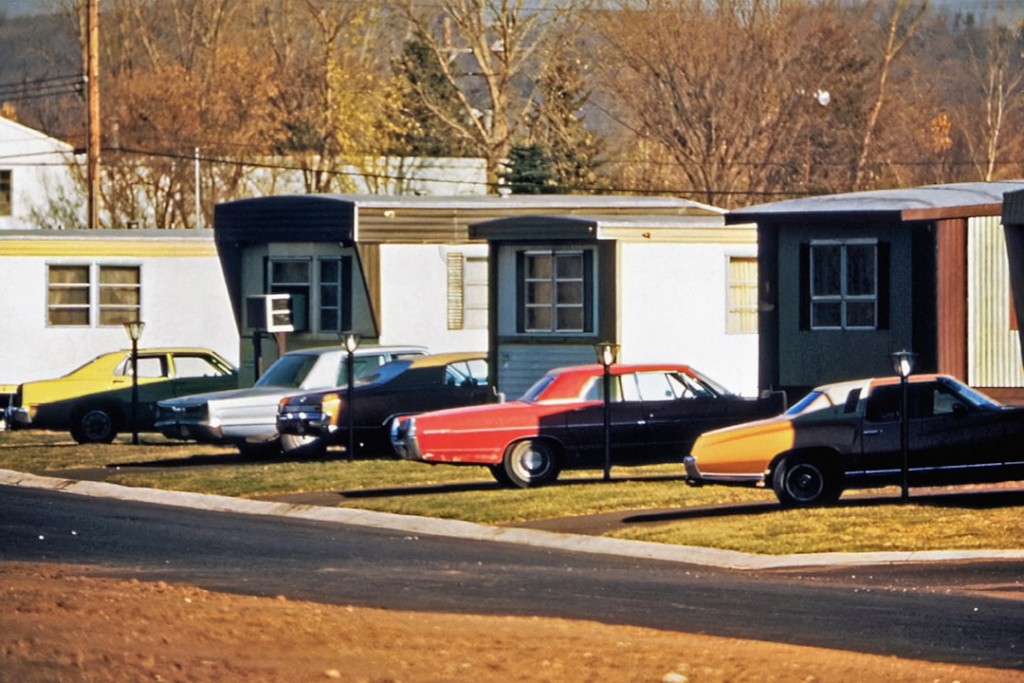
Photo by Documerica on Unsplash
A British tycoon nicknamed “Bob the Builder” just lost $2 billion of other people’s money.[¹] He built his fortune converting mobile home parks into “holiday parks” — a nicer word for the same lots, the same tenants, just repackaged for investors. He bought hair implants and a dozen cars with money borrowed against real estate that housed real people.[²] When it collapsed, the company left holding the bag was Sun Communities — a REIT (Real Estate Investment Trust) headquartered forty minutes from where I used to live.[³]
That’s not a coincidence I get to enjoy from a distance. Sun Communities owns parks in my own county.[⁴] So does a private-equity-backed operator called MHC Capital, which owned the park I lived in for almost ten years.[⁵] So does a company running out of a single-purpose LLC in Chesterfield.[⁶] Different names, same machine. I know what that machine does up close, because I lived inside it.
The money trail, revisited
I’ve written about this before, in the Criminalizing Shelter, I Called It, and We Called It series, and I won’t re-walk the whole thing here — read those pieces if you want the full receipts. But the short version bears repeating, because everything below happened inside a system this money helped build and keeps propping up.
The Michigan Manufactured Housing, RV and Campground Association PAC exists to back candidates who “understand and support” the industry.[⁷] Money’s gone to House Republicans, Senate Republicans, the Michigan House Democratic Fund, and the Michigan Senate Democratic Fund — the Senate Democratic Fund is the single largest recipient, at $49,000.[⁸] Both parties, every time. Spencer Partrich donated roughly $50,032 to that PAC since 2017.[⁹] He’s co-owner of Lautrec Ltd., which runs manufactured home communities across nine states and Canada — and whose residents have documented water quality complaints, with the company’s position being that maintenance from the meter to your home is your problem and your cost.[¹⁰]
That’s not a Lautrec-specific policy. That’s an industry-wide default, and I lived it under a different company’s name. Sun Communities doesn’t cut PAC checks directly — corporate contributions are barred by law — but its leadership and employees contribute personally, and Sun Communities is itself a member of the trade association running that same PAC.[¹¹]
Michigan’s mobile home park laws haven’t been meaningfully updated since 1987. That gap is thirty-plus years of runway for exactly the kind of quiet cost-shifting I watched happen in my own park — maintenance crews cut, vacant units left to rot, notices offloaded onto kids, utility billing handed to a third party with zero accountability to residents. None of it is illegal. That’s the point.

The federal carve-out
Congress just passed a housing bill — the 21st Century ROAD to Housing Act — sold as a crackdown on corporate landlords buying up the housing market. It bans large institutional investors from purchasing single-family homes.[¹²] Bipartisan. Applauded on both sides.
Manufactured homes are exempted from that ban by definition.[¹³] Written out. The one housing type where this exact kind of consolidation is most aggressive, and most damaging to the poorest and oldest people who live in it, doesn’t count as housing this law was built to protect. Meanwhile the same bill loosens manufactured housing construction rules and raises FHA loan limits — easier to finance, easier to build at scale, easier for the MHC Capitals and Sun Communities of the world to keep doing exactly what they’re doing.[¹⁴]
What it looks like from a lot rented
I lived at Parkway Village — 242 sites, built on the old Mount Clemens/Clinton Township racetrack (or so the story goes), laid out in an oval with one way in/out.[¹⁵] Owned, for the years I was there, by MHC Capital LLC — a private-equity-backed operator with 28 parks and roughly 4,700 sites across Ohio and Michigan, about a quarter of them in this state.[¹⁶]
When I moved in, lot rent was around $250 a month, water included. By 2026, renewal would have run $500, water no longer lumped in. Doubled, over a decade, for a lot with no clubhouse, no pool, no amenities — just an old central playground that looked like it hadn’t been updated since the ‘80s and that I never saw a parent let their kid use unsupervised.
Water didn’t stay included. A few years in, a notice went out: the park was switching to a third-party billing company, Universal Utilities — a company with a documented pattern of unexplained bill spikes, junk fees, and residents left without regulatory recourse because they’re not direct utility customers.[¹⁷] I’d already had my pipes insulated and heat-taped myself. When the park switched to them they came out to install their meters, they cut my heat tape without telling me, during that install. That winter, my crock froze. I wasn’t Universal Utilities’ customer — I was just the person they billed, and I had to deal with the aftermath.
Disinvestment, on schedule
When I first moved in, the park had an in-house maintenance man and his son, paid to keep the place up and flip vacant trailers for resale. There was an elderly man doing informal night security. The park manager lived on-site — first trailer in the lot, the one with the advertisement for the park on the side, was the manager’s perk.
By the time I left, all of that was gone. Four park managers cycled through in ten years, and every one of them promised the same things — new lock mailboxes, repaved roads, since the roads are full of potholes that could swallow a car — and none of it ever happened. When my mailbox rusted through, the second manager tried to tell me the new ones were coming eventually, “we’re getting the nice lock ones soon.” I’d heard that for five years already. By then there was no maintenance crew left to install anything. She left my replacement mailbox in its cardboard box on my porch for me to figure out myself. It took me and another park resident some time to try to take out my old mailbox and install the new one. I also had to replace the numbers myself for the box.
That same manager didn’t want to do their job to drive the park to post notices herself, which had always been the job of the park manager. Instead, she had a couple of young girls who lived in the park tape notices to people’s doors and porches — and if the weather took them down before residents saw them, so be it. I filed a complaint with the main office over it. It was a real safety issue, and it came from a manager not wanting to do her own job, not from a staffing cut this time.
The maintenance crew’s job had only ever been to repair vacant units for resale — once I bought my trailer outright, every repair was mine. A leaking roof I patched and tarred with my family’s help. Ceiling tiles I replaced myself. That was the deal, and I didn’t dispute that deal. But when the park quietly stopped paying that crew, there was no one left to maintain the vacant homes either. They sat empty and rotted. They drew rats. People broke in.
That neglect is what brought the city out for inspection — not resident homes, the vacant ones. The park told me and every other resident it was us being inspected. I called the city myself and got the real answer. When I confronted the manager and the head office with what the city had actually told me, both lied to my face anyway.
That same year I got a notice: repairs and cleanup, due in three days, or fines would start stacking on top of my lot rent until they were done. Three days, for someone disabled, living alone, needing to line up help. I fought it — found ADA case law establishing they had a duty to accommodate a documented disability with realistic time — and bought myself room. It cost me physically; the stress flared my conditions. Friends showed up because I posted about it online, not because the park did anything but threaten me.
The park had let its own vacant inventory rot for lack of staff, then used the resulting inspection as a pretext to squeeze occupied residents — including the one who’d been paying for every repair on her own home for years — with a fine clock they controlled and I didn’t.
Around the same time, a tree crew came through to clear brush along the old railroad line behind the park. The manager gave them permission to use my lot without asking or telling me first. I have two service dogs I couldn’t let out all day while strangers worked the yard. They left divots in my lawn I could have lost my deposit over, threw my property-line fencing wherever, and butchered trees that gave my home its shade, leaving the cuttings behind. My lot, my liability, someone else’s decision.
Who absorbed the difference
Most of the people living in that park were elderly, disabled, or immigrants or other cultures — a strong Latino community, neighbors who fixed up homes with their own hands and passed them down when they moved on. One elderly neighbor of mine, who didn’t speak much English, fixed up her home beautifully, had her son move in with her for a while, and eventually got a place in town — she gave her trailer to family further down the road when she left.
I watched other neighbors die in the homes they’d built a life in. I watched a manager hand out access to their belongings to whoever she was friendly with — go take their flowers, whatever’s in the shed — before family could even get there. Grave robbing, basically, with permission slips.
None of this reads as one bad manager or one unlucky park. It’s what happens, on a schedule, when the staff who used to hold a place together get cut or made to disappear, the savings get pocketed, and the difference gets made up out of the residents who have nowhere else to go.

The replacement model
Neglect is only half of it. The other half is what moves in once the old homes are gone.
Instead of repairing aging units, park owners take them out and bring in new doublewides in their place. A new doublewide that would have run somewhere around $40,000 a decade ago — back when I was still finding extreme fixer-upper actual houses for $10,000 to $20,000 — comes with a lot rent to match. New unit, new price bracket, and the lot rent for that space doubles along with it.
It’s the same math playing out at every rung of the ladder, and it starts before any of this. Rising property taxes squeeze homeowners first — the same property tax “relief” being debated in Lansing right now, including elimination of the real estate transfer tax, disproportionately benefits large-portfolio buyers over the individual homeowner it’s marketed to.[¹⁸] When owners can’t keep up, they sell, and that’s the opening investors have been waiting for: buy the house, turn it into a rental.
We’ve watched the same thing happen to apartments for years — a company buys the building, pushes out who’s there, upgrades the units, rents them back out at double or triple what they were.
We’ve watched it happen to single-family homes, bought up, flipped, and rented back to people who’ll never get to own them.
Manufactured housing was supposed to be the floor under all of that — the one option left when you couldn’t rent or own anything else.
It isn’t anymore.
This is how you push out elderly and disabled residents on fixed incomes without ever writing a policy that says so. You don’t have to evict anyone directly. You just stop repairing what’s already there, replace it when it finally fails, and let the new lot rent do the work. My own approval income, if I were approved today, would land just over $1,000 a month. My bills at Parkway Village — before the $500 lot rent even kicked in, and before it would have risen again — were already running just under $2,000 a month between utilities, water, gas, food, and car insurance, etc. I couldn’t have afforded to stay in one of the cheapest parks left in Michigan. Not because I mismanaged anything. Because the number the park needed and the number a fixed income could produce stopped being the same numbers years ago.
So: if you can’t own a home, can’t afford an apartment, and now can’t afford one of the last cheap manufactured lots in the state either — where do you go. Where do you live.
And then, when the only place left is your car, they write a law to make that illegal too, and start striping the lands you can stay at.
That’s the conveyor belt. Not a metaphor. A method, working exactly as designed, one lot rent increase at a time.

Sources/footnotes:
*REIT = Real Estate Investment Trust
[¹] Bob Bull Jr. net worth, RoyaleLife bankruptcy — Wikipedia, “Bob Bull,” citing Bloomberg News, “The Bankrupting of a Mobile Home Billionaire” (June 2026) and The Daily Telegraph (Aug. 2023)
[²] Robert Bull Jr. background and lifestyle — “The Caravan King,” MHP Weekly (Substack), Oct. 2023
[³] Sun Communities and RoyaleLife/Bull loan relationship — Crain’s Detroit Business, via Kirk Pinho, LinkedIn (July 2026); “The Caravan King,” MHP Weekly
[⁴] Sun Communities Michigan properties, including East Village Estates, Washington Township — suncommunities.com
[⁵] MHC Capital LLC portfolio — Private Equity Stakeholder Project, “PESP Private Equity Manufactured Housing Tracker”
[⁶] Carriage Way ownership under Carriage Way of Chesterfield LLC — liveatcarriageway.com
[⁷] MMH & RVCA PAC purpose statement — mmhmembers.org, “Political Action Committee”
[⁸] MMH & RVCA PAC top payees and recipients (Michigan Senate Democratic Fund, Aric Nesbitt, Matt Hall, Sam Singh, Michael Webber) — Transparency USA, Michigan Manufactured Housing RV and Campground Assn PAC committee page
[⁹] Spencer Partrich contributions to MMH & RVCA PAC since 2017 — Transparency USA
[¹⁰] Lautrec Ltd. ownership and resident water quality complaints — previously cited in “Criminalizing Shelter, Michigan’s New…”
[¹¹] Sun Communities individual/employee political contributions ($44,101, 2022 cycle) and MMHA membership listing — OpenSecrets, Sun Communities organization profile; michhome.org, “About Michigan Manufactured Housing Association”
[¹²] 21st Century ROAD to Housing Act, institutional investor restriction on single-family homes — Wikipedia, “21st Century ROAD to Housing Act”; became law July 11, 2026 after President Trump declined to sign — The Hill, NPR
[¹³] Manufactured homes excluded from “single-family home” definition under the Act — Greenberg Traurig LLP, “The 21st Century ROAD to Housing Act: Considerations for Large Institutional Investors”; Latham & Watkins, “Senate Advances 21st Century ROAD to Housing Act”
[¹⁴] Elimination of permanent chassis requirement, FHA manufactured housing loan limit increases — Yahoo Finance, “What the housing affordability bill means for buyers and sellers”; Bipartisan Policy Center, “What’s in the 21st Century ROAD to Housing Act?”
[¹⁵] Parkway Village site count and history — Michigan Manufactured Housing Association community listing; MHVillage
[¹⁶] MHC Capital portfolio size and Michigan concentration — PESP Private Equity Manufactured Housing Tracker
[¹⁷] Universal Utilities billing practices, documented complaints — AZ Luminaria, “Broken utility bill system can mean eviction for some mobile home…”; Grand Blanc Township water payment case, WJRT ABC12 (Sept. 2023)
[¹⁸] Michigan property tax overhaul, real estate transfer tax elimination, House Speaker Matt Hall’s plan — Bridge Michigan, “Matt Hall pitches $4B Michigan tax overhaul”; Detroit News, “Michigan House speaker floats nearly $5B in property tax cuts”