

The white nationalist movement that MAGA has absorbed is aiming to replace multiracial democracy with an ethnostate. Here’s why MAGA doesn’t perceive this as ‘racism’.
The View From Within | Brandon Watson
Originally published May 31, 2026.
7provtruths.substack.com
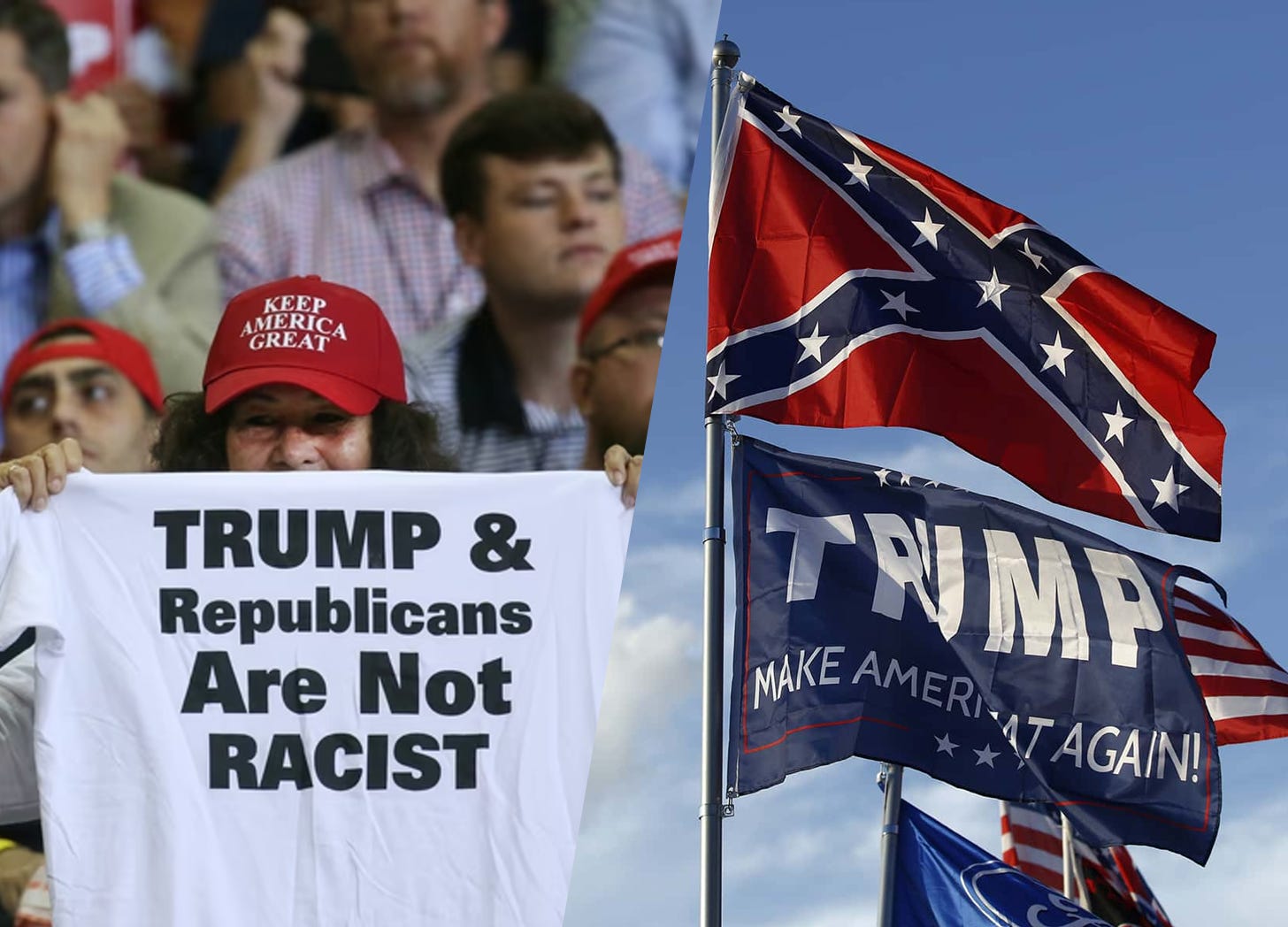
Freedom And Justice For Some
The United States didn’t start off as a democracy.
The republic began as an ethnostate where the substance of democracy was reserved for a privileged in-group: namely, white male landholders.
This in itself was unremarkable: most countries on Earth were ethnostates when the US Constitution was penned. What was distinctive about the United States was the internal contradiction it was born with – one that would set the stage for two and a half centuries of internal conflict over who ‘We The People’ actually includes.
When Thomas Jefferson wrote that ‘all men are created equal’, it was understood at the time that ‘all men’ didn’t actually include everyone. And this wasn’t simple hypocrisy; back in Jefferson’s time, humanity itself was a graded category. One where some ‘men’ were more fully human than others, a hierarchy that was so natural and intuitive that questioning it would have been like questioning gravity. While different thinkers at the time sliced up the gradations in different ways – with some radicals even going so far as to extend full humanity to slaves – very few imagined a world without it. Yet the seed of contradiction was planted from the very beginning, and would grow into demands that would be impossible to contain.
The road from ethnostate to multi-racial democracy has been a long and grinding one. Every expansion of this in-group to include more people under its fold has been met with fierce resistance every step of the way. From abolition to women’s suffrage to the dismantling of Jim Crow, democratization has been purchased through beatings and blood. The 8 hour workday and the end of segregation didn’t just ‘happen’: brave people put their safety and freedom on the line to force open doors that were never meant for them.
It was only with the passage of the Civil Rights Act of 1964 and the Voting Rights Act of 1965 that the United States could, for the first time, plausibly be considered a full-democracy in-practice, securing civil and political rights for all citizens. Together, they formed the two core pillars of America’s experiment in multi-racial democracy: the CRA securing civil rights for all citizens regardless of race, and the VRA securing the political machinery necessary to secure them.
For anyone keeping tabs, that’s roughly 60 years, about one quarter of our 250 year history, where our self-professed democratic values have come anywhere close to being realized in practice.
Salvaging Jim Crow
Which brings us to the elephant in the room: as of April 29, 2026, thanks to a 6-3 SCOTUS decision in Louisiana v. Callais, the Voting Rights Act, for all practical purposes, no longer exists. The ACLU breaks it down in more depth and clarity than I ever could here. But the gist of the attack that killed the VRA is that using race to ensure that black Americans have access to meaningful political representation is itself ‘racist’ towards white Americans. The six conservative justices, half of whom were appointed by Trump, found this argument convincing. And within days of the decision, states like Tennessee and Louisiana have put the pedal to the floor to gerrymander black congressional districts out of existence.
And the Callais decision isn’t a one-off, catastrophically bad as it may be. The same reactionary forces that have successfully eviscerated voting rights in the United States are gunning to overturn birthright citizenship, as part of a broader assault on the 14th and 15th Amendments.
Clearly, what we’re witnessing isn’t partisan politics as usual, but a coordinated effort to resurrect a sham ‘democracy’ where vast segments of the population are subjugated to the bottom rung of a dominator hierarchy – all while being told that they live in the freest country on Earth.
Clawing America Back To Its Roots
Let’s clear up one misconception, right out of the gate: the Callais decision isn’t ‘anti-American’. It’s a regression to a version of America that many naive people assumed was well behind us.
This is what clawing the country back to its roots – to an ethnostate where ‘democracy’ only exists for a privileged few – looks like in practice. Those who opposed the Civil Rights Movement didn’t pack up their bags, go home, and return to civic participation with a more enlightened outlook. They regrouped. And they strategized.
Because those who benefit from unjust power hierarchies don’t just step aside through convincing arguments. They dig in, use every lever of power at their disposal to fight back, and when that fails: they adapt.
Lee Atwater, architect of the Republican Party’s so-called Southern Strategy to court white racists, laid it out with surprising candor in a 1981 interview, under a mistaken assumption that he was speaking off the record:
“You start out in 1954 by saying, “N*****, n*****, n*****.” By 1968 you can’t say “n*****”—that hurts you. Backfires. So you say stuff like forced busing, states’ rights and all that stuff. You’re getting so abstract now [that] you’re talking about cutting taxes, and all these things you’re talking about are totally economic things and a byproduct of them is [that] blacks get hurt worse than whites.”
– Lee Atwater, interview with Alexander Lamis, 1981. Published in The Two-Party South (1984). Audio released by The Nation, November 2012.
The Southern Strategy is adaptation in action. It’s what happens when the underlying incentives haven’t changed, but the social and political environment has. The racial resentment never fully went away – it just found a new home, adopted new tactics. Thus did the party of Lincoln, roughly a century later, become the heir apparent of the Confederacy. Not through conviction, but through crass opportunism.
Very few modern Republican voters are outright white supremacists. But they don’t need to be. They just need an ‘out’ that allows them to be okay with being aligned with racists. For some that will be black acquaintances or colleagues. For others it will be personal kindness to individuals, treating everyone in their day-to-day lives with respect regardless of their race. And for yet others it will be single issue voting or ‘both sides’ equivocation. Regardless of their chosen ‘out’, the outcome is the same: the project to rebuild the ethnostate gets their support. Even if a great many of them would recoil from the endgame, were it stated plainly.
In a post-civil rights era, the name of the game is to deliberately exploit ambiguity that’s intrinsic to language itself – the fact that words land differently depending on who’s listening – to cultivate and exploit racial resentment with a degree of plausible deniability.
And this points to something crucially important about that ambiguity. It allows us to absorb ideas and assumptions without necessarily understanding where they came from, or what they’re intended to accomplish.
There’s No Agreed Upon Definition Of ‘Racism’ That Survives The Cultural-Political Divide
Talk to two Americans who are on opposite sides of the Culture Wars, and you’ll get two very different answers about what ‘racism’ is, and by extension – who qualifies as a ‘racist’. And the difference runs deeper than what type of media we consume. While it’s not hard to predict whether someone’s media diet consists of Fox News or NPR from how they answer this question, the essential point is that media consumption follows a person’s dispositions – not the other way around.
Because here’s the thing about our attitudes and beliefs: they aren’t something we consciously ‘choose’, like items on a takeout menu. They instead emerge through our messy entanglement with the everyday world. Put simply, we bring the life we’ve lived to how we reason, what facts we accept, who gets treated as an authority, and who gets dismissed out of hand. Moreover, human intelligence is innately social. The overwhelming majority of our sensemaking isn’t worked out from first principles – for most things, this would be the equivalent of using a bulldozer to drive in a nail. Our initial footing is almost always rooted in cultural templates that we adapt or invert to fit our lived circumstances.
Reason plays a role in this process, just not the leading one: its primary role is to justify our existing beliefs; reconsidering them is secondary. Which isn’t to say that our intuitions – and the dispositions that inform them – are beyond scrutiny. Given enough time and motivation, they can gradually be noticed and examined. This is the bread and butter of not only therapy, but many forms of spiritual practice, which are about learning to see what we couldn’t before. This work is usually slow and unglamorous. It’s also cognitively and emotionally taxing – which is why we usually go out of our way to avoid it.
Which brings us back to our inability to arrive at an uncontroversial agreement on what racism is, and how it behaves in a modern context. We’re not talking about a dictionary definition, divorced from what’s at stake for us when the topic enters the room, but how the concept of ‘racism’ itself gets applied in the real world. About the only thing that survives the crossing of that political-cultural divide is that ‘it’s bad’. Who or what counts as ‘racist’, on the other hand, is where the wheels come off and the bus careens over a cliff.
Couplers And Decouplers
This disagreement isn’t arbitrary – it cuts to the heart of our ground-level assumptions about what’s real, what’s relevant, what matters. The term that philosophers use for this is ontology, but what it’s called isn’t as important as what it reveals: that a large portion of our reasoning starts from a place that we didn’t choose and can’t easily see.
Writer and blogger John Nerst offers a useful model for thinking about these two very different ways putting the cart before the horse, as far as how it’s perceived from the other side. Nerst’s account of decoupled versus coupled thinking draws a distinction between two fundamentally different starting points for what counts as relevant – and why. It goes a long way towards explaining why conversations on emotionally charged subjects – such as racism – go nowhere.
What follows is an application of Nerst’s framework, filtered through a particular perspective and set of concerns. The original version in Nerst’s own words can be read here, if you want to compare notes. The gist of the distinction is about how much of the surrounding social and political context gets counted as relevant to a particular issue. Decouplers are more likely to bracket the surrounding connotations while evaluating a claim, while couplers insist that the background context can’t be separated from the claim itself.
To draw from an example that Nerst himself used to illustrate the distinction, consider the question of racial differences in IQ. To the decoupler, this is an empirical question whose truth or falsity is a separate matter from its social and political implications. To the coupler, there’s no innocent way of asking the question because the racist context in which it’s been posed is inseparable from its meaning. Just like asking a new couple when they’re planning on getting married and having kids, just bringing up the question presupposes a lot. In the case of the racial IQ question: that the inquiry itself is value-neutral, that ‘race’ is coherent biological category, and that IQ measures something real.
While most of us have a dominant orientation one way or the other, there’s a crucial nuance: we don’t couple or decouple across the board. We tend to do so opportunistically – decoupling negative connotations for claims we’re inclined to agree with, and coupling them for ones we oppose. And when we apply these decoupling and coupling tendencies to the topic at hand, the result is two conceptions of racism that are so different that calling them by the same name is part of the problem.
So let’s sketch them out.
Old-Fashioned-Racism Vs. Racism-By-Proxy
We’ll call the decoupled version old-fashioned-racism. It’s the direct, unsubtle kind of bigotry that’s easy to recognize. And because of this, it’s fallen out of fashion over the last half century. Even hate groups have learned to make their message palatable for a public that has internalized enough of the civil rights movement to be put off overt displays of racism – as that earlier quote from Lee Atwater clearly illustrates.
The archetype for this kind of racism is Archie Bunker from All In The Family. All In The Family was a 70s sitcom that was groundbreaking for tackling controversial social issues around race, gender, and class, at a time when other TV shows avoided anything that might make a white audience uncomfortable. At the center of All In The Family was Archie Bunker, an unapologetic bigot whose ignorance audiences were meant to laugh at.
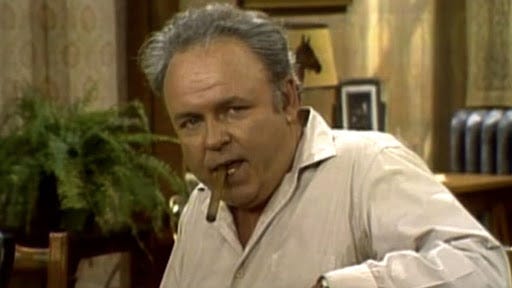
It’s the kind of racism that costs nothing to condemn because it’s already lost. Even bigoted people condemn it, at least performatively. Doing so is easy because it doesn’t implicate the systems and structures that produced it. It frames racism as an individual moral failure rather than a systemic issue, and by this measure it dovetails neatly with the bracketing approach of decouplers.
Now contrast the old-fashioned-racism recognized by decouplers with the racism-by-proxy understanding of its coupled counterpart. Unlike the crude version, this is racism that’s more durable, sophisticated, and considerably harder to pin down in a way that survives the aforementioned cultural-political divide. It achieves its ends beneath a veneer of plausible deniability. The harm it causes to those it targets is presented as incidental to ostensibly economic or political goals.
If Archie Bunker is the archetype for what a racist looks like to a decoupler, then the racism-by-proxy archetype is Ronald Reagan. Reagan never used the kind of slur-laden language that Archie Bunker would. He never called himself a segregationist, spoke about race from his stump speeches, or openly endorsed white supremacy. His sunny, optimistic disposition and folksy mannerisms were disarming for a white audience that was ready to ‘move on’ from civil rights. Yet it was through Reagan’s coded, plausibly deniable backlash to the civil rights movement that the Southern Strategy found one of its most effective champions.
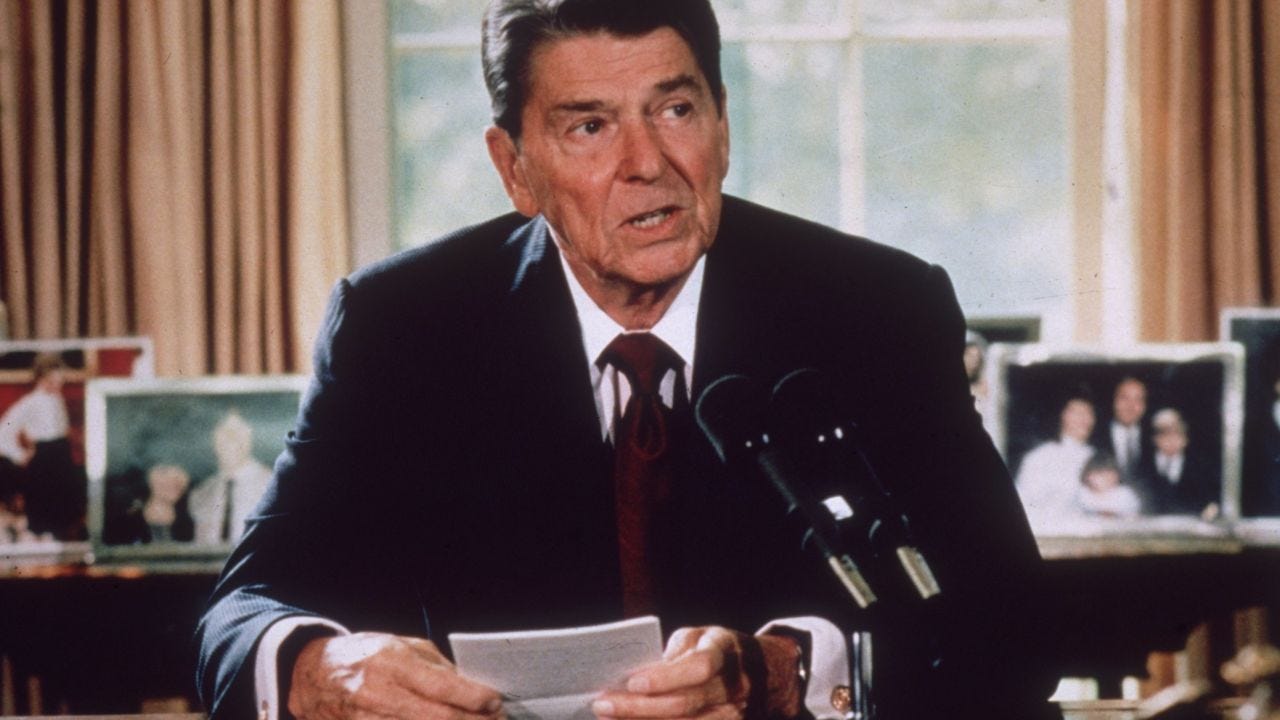
By wrapping policies that hurt black and brown communities beneath a rhetoric of personal responsibility and fiscal conservatism, he was able to court white grievance without the condemnation that old-fashioned-racism invites.
What does this look like practice? Like passing gun control as governor of California, as a direct response to black Americans exercising their 2nd Amendment rights. Like launching his campaign in a Mississippi town where three civil rights workers had been murdered sixteen years earlier, to deliver a speech about states’ rights. Like invoking a fictitious ‘welfare queens’ archetype that put a black face on government dependency, and did the work of racial coding without mentioning race. Or a War On Drugs that was ostensibly about combatting an addiction epidemic, but which focused on incarceration over treatment and was selectively enforced in areas where black and brown people just happened to live.
In each of these cases, race could always be treated as incidental to both intent and outcomes. Those who supported these policies had a plausible ‘out’ that allowed them to support actions that harmed black and brown communities without necessarily harboring any animosity towards them as such.
MAGA: Culpable Ignorance And Moral Laziness
So where does this leave us in regards to MAGA? Does an inhibited understanding of racism that excludes what it actually looks like in a real-world context exonerate Trump supporters from culpability?
Trump himself is a proponent of Great Replacement Theory, a racist conspiracy theory which proports that America’s white, Christian identity is being diluted by brown immigrants. He regularly associates with overt white supremacists like Nick Fuentes. His regime has built a violent paramilitary that’s actively recruiting white nationalists, for the purpose of terrorizing brown Americans into fleeing the country.
When asked about any of this, a Trump supporter might say that all of this is incidental to why they’re supporting him. They like his tough stance on crime. They were expecting him to bring back domestic manufacturing. They’re single issue voters. They don’t like everything he’s done, but Kamala would have been worse. They just wanted a tax cut.
And by their own definition of what racism is, they may be able to square all of this with a sincere belief that they are not a racist. The fact that MAGA supporters include black and brown Americans is proof enough that charges of racism are a partisan smear campaign – the ‘I have a black friend’ argument, writ large.
Trump voters aren’t necessarily white supremacists. They may not subscribe to white nationalism, which refers to the political project to maintain a white, Christian demographic majority within America. They may sincerely be moved by ‘To Kill A Mockingbird’ while failing to connect its lessons to the present. They may have a justified axe to grind with liberals, The Democrats, or urban elites for writing them off as bigots while ignoring their legitimate economic concerns. Or they may be victims of propaganda that was precision engineered for their psychological vulnerabilities, and designed to get them to scapegoat an Other for decades of displacement and decline.
All of these things can be true without being exculpatory. This is what culpable ignorance looks like: not knowing because one doesn’t care to know. And none of it requires that MAGA individuals be evil or stupid.
All that it requires is moral laziness: being disinterested in how your ‘choices’ effect others, particularly those who lie outside of your circle of concern. People and communities you rarely come into direct contact with, whose concerns are easy to dismiss and whose suffering is kept at a comfortable distance.
No one chooses their circle of concern – it’s an organic outgrowth of the life we’ve lived and the situations we’ve been exposed to. But we do have a choice about whether we’re willing to allow ourselves to be changed by subjecting it to scrutiny.
– Brandon Watson, May 2026